Pilot course fees in India start at ₹55 to ₹65 lakh in 2026, and that figure covers only the 200 hours of flying training. Ground school, exams, living costs and the airline type rating sit on top, taking the full journey to roughly ₹75 to ₹95 lakh. Those numbers scare many families before anyone explains what they actually pay for. This guide breaks down the fees licence by licence, shows realistic timelines, compares your options, and walks you through funding the training without wrecking the household budget.
What a pilot course in India actually includes
When people say “pilot course”, they usually mean the path to a Commercial Pilot Licence (CPL) issued by the Directorate General of Civil Aviation (DGCA), India’s aviation regulator. The course has two halves, the Ground Theory and Flight Training.
The first half is ground school. You study six DGCA subjects, sit computer-based exams, and clear the RTR(A) radio telephony exam, which DGCA itself has conducted since late 2025. Structured DGCA ground classes compress this phase and cut repeat attempts, which quietly save money later.
The second half is flying. DGCA requires 200 hours of flight time for a CPL, logged at an approved Flying Training Organisation (FTO) in India or at a recognised school abroad followed by licence conversion. Flying hours are the single largest cost in the entire course, so the school you pick and how efficiently it flies you matters more than any brochure discount.
A third cost arrives after the licence: the type rating, which trains you on a specific airliner such as the A320 or B737. Airlines expect it, and it is almost never included in the quoted course fee.
If you are still mapping the whole journey, our guide on how to become a pilot in India covers eligibility and the route end to end.
Pilot course fees in India at a glance (2026)
Here is where pilot course fees in India stand for each licence stage in 2026. Treat these as realistic planning ranges, not quotes; fuel prices, aircraft type and location all shift the final bill.
| Licence / stage | What it is | Typical fees (2026) | Typical duration |
|---|---|---|---|
| Student Pilot Licence (SPL) | Entry permit to begin training | ₹50,000 – ₹1 lakh (often bundled into CPL) | 2 – 4 weeks |
| Private Pilot Licence (PPL) | Fly privately, not for pay | ₹15 – ₹20 lakh | 6 – 9 months |
| Commercial Pilot Licence (CPL) | Fly commercially; the main course | ₹60 – ₹75 lakh all-in (₹55 – ₹65 lakh of it is flying) | 18 – 24 months |
| Type rating (A320/B737) | Airline aircraft qualification | ₹15 – ₹20 lakh | 2 – 3 months |
| ATPL (later, in service) | Captain-level licence | ₹4 – ₹8 lakh (exams and upgrades) | After airline induction |
Two things stand out. First, the CPL dominates the budget, and almost all of it is flying hours. Second, the ₹55 to ₹65 lakh figure you hear quoted is the flying training alone. Ground school, exams, living costs and the type rating are all additional, which is how the full journey reaches ₹75 to ₹95 lakh. Nobody pays it on day one; it spreads over roughly two years.
Pilot course fees in India after 12th: what school leavers should know
Most cadets start straight after Class 12, and the fee structure is identical whether you join at 17 or at 27. What changes is the preparation runway. You can hold a Student Pilot Licence at 17 and a CPL at 18, so a school leaver who plans well can be employable before classmates finish their first degree.
Your stream decides the entry paperwork. Science students with Physics and Maths walk straight in. Commerce and arts students clear those two subjects through NIOS on-demand exams first, which costs a few thousand rupees and adds three to six months. That is the entire penalty; airlines do not care which board or stream you came from once the licence is in hand.
One budgeting note specific to younger cadets: parents often compare pilot course fees in India against a four-year engineering degree plus placement uncertainty. The pilot route costs more upfront, but it compresses the earning timeline by two to three years, which changes the comparison once you run the numbers over a decade. Some families also pair the CPL with a distance degree as a fallback, adding ₹1 to 2 lakh over three years.
How long does a pilot course take?
Duration matters as much as pilot course fees in India, because every extra month adds hostel rent, food and lost earning time. A realistic timeline looks like this.
| Phase | What happens | Typical time |
|---|---|---|
| Class 2 then Class 1 medical | DGCA medical assessments | 1 – 2 months |
| Ground school + DGCA exams | Six subjects plus RTR(A) | 4 – 8 months |
| Flying training (200 hours) | At an FTO in India or abroad | 10 – 14 months |
| Licence issue via eGCA | Paperwork and verification | 1 – 3 months |
| Type rating | Simulator-based airline course | 2 – 3 months |
Add it up and the honest answer is 18 to 24 months for most cadets, with disciplined students finishing closer to the lower end. The flying phase is where timelines slip badly at overbooked schools; aircraft availability, weather planning and instructor strength decide whether your 200 hours take ten months or twenty. A well-run commercial pilot training programme in India can complete the flying phase in around 10 months, which is one of the strongest arguments for choosing your FTO carefully rather than cheaply.
Students without Physics and Maths in Class 12 add a few months to clear these subjects through NIOS before starting, so factor that in if you are from a commerce or arts background.
CPL cost breakdown: where the money actually goes
The headline number becomes less frightening once you see the components. Here is a realistic breakdown of commercial pilot course fees in 2026.
| Cost component | Typical range (2026) |
|---|---|
| Flying training, 200 hours | ₹55 – ₹65 lakh |
| Ground school coaching | ₹1.5 – ₹3 lakh |
| DGCA exam and eGCA fees | ₹25,000 – ₹50,000 (across attempts) |
| RTR(A) exam and preparation | ₹30,000 – ₹75,000 |
| Class 1 and Class 2 medicals | ₹25,000 – ₹50,000 |
| Study material and equipment | ₹50,000 – ₹1 lakh |
| Hostel and living, 18-24 months | ₹3 – ₹5 lakh |
| CPL subtotal | ₹60 – ₹75 lakh |
| Type rating (separate, later) | ₹15 – ₹20 lakh |
| Full journey to an airline cockpit | ₹75 – ₹95 lakh |
Flying hours are close to nine tenths of the CPL bill, which is why per-hour rates deserve more attention than any other line in a school’s quotation. A school charging ₹500 less per hour saves you around ₹1 lakh across 200 hours, but only if its aircraft actually fly on schedule. An idle month at a cheap school costs more than the savings.
Exams are the opposite story. Each DGCA paper costs only a few thousand rupees through the eGCA portal, yet weak preparation multiplies attempts and stretches your timeline. This is the cheapest part of the course to get right the first time.
Government vs private flying schools: fees compared
Families often assume government institutes cut pilot course fees in India by half. The gap is smaller than you’d expect.
| Factor | Government institutes | Private FTOs |
|---|---|---|
| CPL fees (all-in) | ₹55 – ₹70 lakh | ₹60 – ₹75 lakh |
| Entry | Entrance exam, limited seats | Rolling admissions |
| Waiting time | Long; batches fill fast | Usually shorter |
| Fleet and scheduling | Varies by institute | Varies widely; inspect before joining |
| Loan support | Strong, established tie-ups | Depends on the school |
Government academies such as IGRUA publish all-in fee structures in the same territory as reputable private schools, and their entrance exams admit only a small batch each year. The real decision is not government versus private. It is a school that flies you consistently versus one that doesn’t, and that question is answered by fleet size, instructor count and current student load, not by ownership.
Cadet programmes vs the standard CPL route
Airline cadet programmes are the other fee structure you will encounter while researching pilot course fees in India. In a cadet programme, an airline such as IndiGo or Air India selects you before training begins, prescribes the flight school, and holds a conditional pathway to its own cockpit at the end.
The trade-off is straightforward. Cadet programmes typically cost more, often around ₹1 crore or above once the type rating and airline assessments are bundled in, against ₹75 to ₹95 lakh for the standard route of CPL plus type rating taken independently. What you buy for the difference is certainty: a defined airline pathway instead of applying to open first officer intakes after your licence.
Neither route is automatically better. A cadet seat suits families who can fund the higher figure and value the pathway; the standard route suits those who want a lower bill and are confident competing in open recruitment, which stays active while fleets grow. We have broken down the individual schemes in our guides to the IndiGo cadet pilot programme and the Air India cadet pilot programme, including their fee structures and selection stages.
Training in India vs abroad: what changes
Many Indian cadets complete their flying hours overseas and convert the licence to DGCA on return. The totals often land in the same range, but the structure differs.
| Route | Typical all-in cost | Flying phase duration | Watch out for |
|---|---|---|---|
| India (DGCA direct) | ₹60 – ₹75 lakh | 16 – 18 months | School scheduling quality |
| USA (FAA, then convert) | ₹65 – ₹70 lakh + conversion | 12 – 14 months | Visa, exchange rate, conversion exams |
| New Zealand / South Africa | ₹60 – ₹75 lakh + conversion | 15 – 16 months | Conversion time back in India |
Pilot course fees in India buy you a DGCA licence directly, with no conversion step at the end. Abroad, you often fly more consistently thanks to better weather windows and larger fleets, and the dollar rate decides whether the route saves anything. Conversion back to a DGCA licence adds exams and a few months. If that route interests you, see our detailed page on pilot training in the USA for how the numbers work out.
Hidden costs most students miss
Quotations rarely lie, but they often omit. Ask every school you shortlist about these items, because together they add ₹3 to ₹8 lakh to naive budgets:
- Repeat flying hours beyond the 200-hour minimum, if check flights don’t go well
- Landing, navigation and airport charges billed separately from the hourly rate
- Uniform, headset, chart subscriptions and iPad or EFB apps
- Medical renewals and travel to DGCA-empanelled doctors
- Exam re-attempt fees and extra coaching if a subject needs a second run
- Hostel deposits, mess charges and travel home during weather breaks
- Licence conversion costs, if you train abroad
A 10 to 15 percent buffer over the quoted pilot course fees in India is not pessimism. It is standard financial planning, and schools respect students who ask these questions early.
How to plan and fund your pilot training: step by step
Here is the sequence we recommend to every cadet family before paying the first instalment.
- Clear a DGCA Class 2 medical first. It costs a few thousand rupees and confirms you are medically eligible before any large payment. Upgrade to Class 1 soon after.
- Build the full budget, not the brochure budget. CPL fees, type rating, living costs and the hidden items above, with a 10 to 15 percent buffer.
- Get itemised quotations from at least three FTOs. Insist on per-hour rates, what the quote excludes, and the current average time students take to finish 200 hours.
- Explore secured education loans early. Indian banks fund pilot training against collateral, and several offer aviation-specific products. Processing takes weeks, so start before admission season.
- Hunt for scholarships and airline pathways. A handful of state schemes, women-in-aviation scholarships and airline cadet programmes offset costs. Cadet programmes cost more upfront but bundle an airline pathway.
- Pay in milestones, never in bulk. Reputable schools accept stage-wise payments tied to flying hours completed. Treat any demand for the full amount upfront as a red flag.
- Track everything on eGCA. Your exams, medicals and licence application all live on the portal. Staying current avoids expensive idle months at the end.
Is a pilot course worth the fees in 2026?
Are pilot course fees in India worth paying at all? The hiring data supports a straight yes for committed students. Indian carriers have more than 1,500 aircraft on order, led by Air India and IndiGo, and every new airframe needs crews. DGCA issued a record number of CPLs in 2023, around 1,600, and issuance has stayed strong since, per DGCA’s own data. Globally, Boeing’s Pilot and Technician Outlook projects a need for roughly 6.6 lakh new pilots worldwide over the next two decades, with India among the fastest-growing markets.
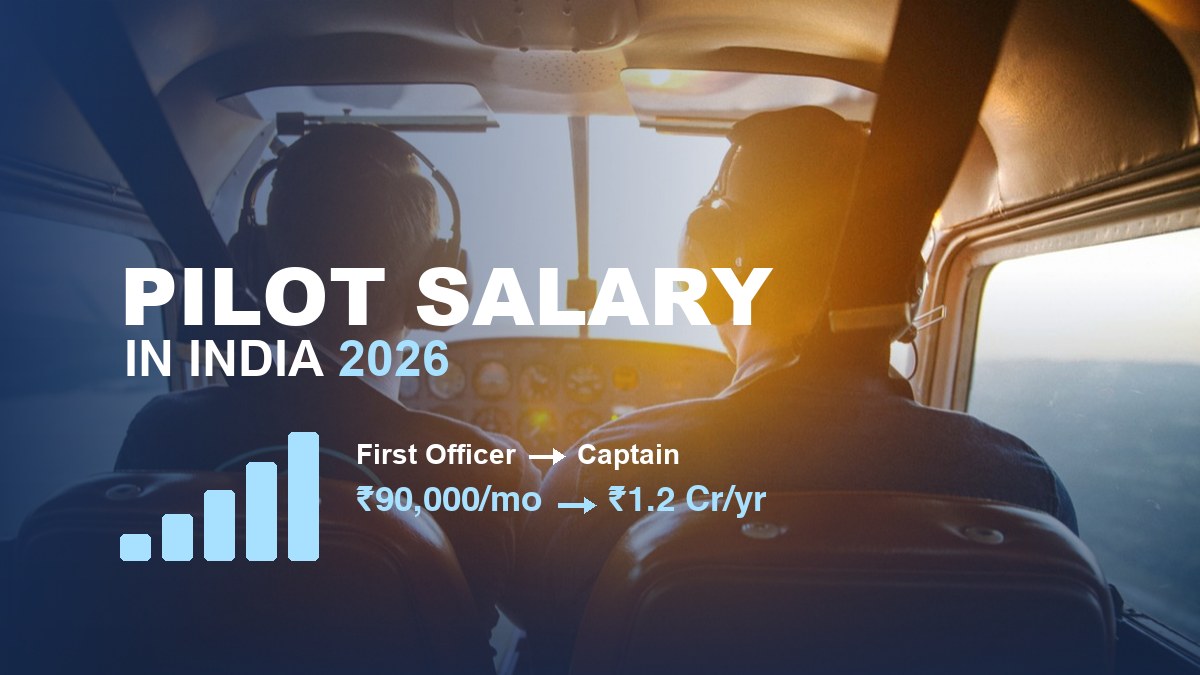
Set that against earnings. A first officer at a major Indian carrier typically starts around ₹1.5 to ₹2.5 lakh per month, and captains earn several times that. Our detailed guide on pilot salary in India runs the airline-wise numbers, but the short version is that a working pilot typically recovers the full training cost within the first four to six years of flying. Few careers with a two-year training runway offer that payback curve.
The honest caveat: the payback only works if you finish. Budget shortfalls mid-course are the most common reason students stall, which is why the planning steps above matter as much as choosing a school.
Training is the expensive half of the equation. The payoff side — what pilots earn once they’re flying — is covered in our full pilot salary guide.
Frequently asked questions
How much are pilot course fees in India in 2026? Plan for ₹55 to ₹65 lakh for the 200 hours of flying training alone. Ground school, exams, medicals and living costs add roughly ₹5 to ₹10 lakh on top, and the airline type rating adds ₹15 to ₹20 lakh later, taking the total journey to roughly ₹75 to ₹95 lakh spread over about two years.
How long does a pilot course take in India? Typically 18 to 24 months from first medical to CPL in hand. Ground school and DGCA exams take 4 to 8 months, the 200-hour flying phase takes 10 to 14 months at a well-run school, and licence paperwork adds a month or two. The type rating is a further 2 to 3 months.
Are government flying schools cheaper than private ones? Not dramatically. Government institutes such as IGRUA publish all-in CPL fees in the ₹55 to ₹70 lakh range, similar to reputable private FTOs, and seats are limited by entrance exams. Compare schools on aircraft availability and completion timelines rather than ownership.
Does the pilot course fee include type rating? Almost never. Quoted CPL fees cover training up to the licence. The type rating on an A320 or B737 is a separate course costing ₹15 to ₹20 lakh, usually taken after CPL issue or through an airline cadet pathway that bundles it.
Can I get an education loan for pilot training in India? Yes. Most large Indian banks extend secured education loans for DGCA-approved training, typically against property or deposits, and some NBFCs offer aviation-specific products. Start the process two to three months before admission, and borrow against an itemised quotation rather than a lump-sum figure.
Can I do a pilot course after 12th without Physics and Maths? You can. Commerce and arts students clear Physics and Maths through NIOS on-demand exams before starting CPL training. It adds a few months and a small cost, after which eligibility matches any science student’s.
Final thoughts
Pilot course fees in India are a serious investment, but they are a knowable one. The ranges in this guide let you build an honest budget: ₹55 to ₹65 lakh for the flying training, ₹5 to ₹10 lakh for ground school, exams and living, ₹15 to ₹20 lakh for the type rating, a sensible buffer on top, and 18 to 24 months of committed effort. The families who struggle are almost always the ones who planned around a brochure number instead of a full one.
If you want those numbers made specific to your situation, school options and funding route included, book a free counselling session with ThePilot.in. Your guide to fly.