How to Become a
Pilot in India
FEES, TRAINING, SALARY & COMPLETE GUIDE 2026
Everything you need to know about becoming an airline pilot in India including eligibility, DGCA medicals, training costs, flying hours, cadet programs, pilot salaries, and airline career opportunities.
Written by ThePilot.in Editorial Team Reviewed by Capt. Hardik Jani
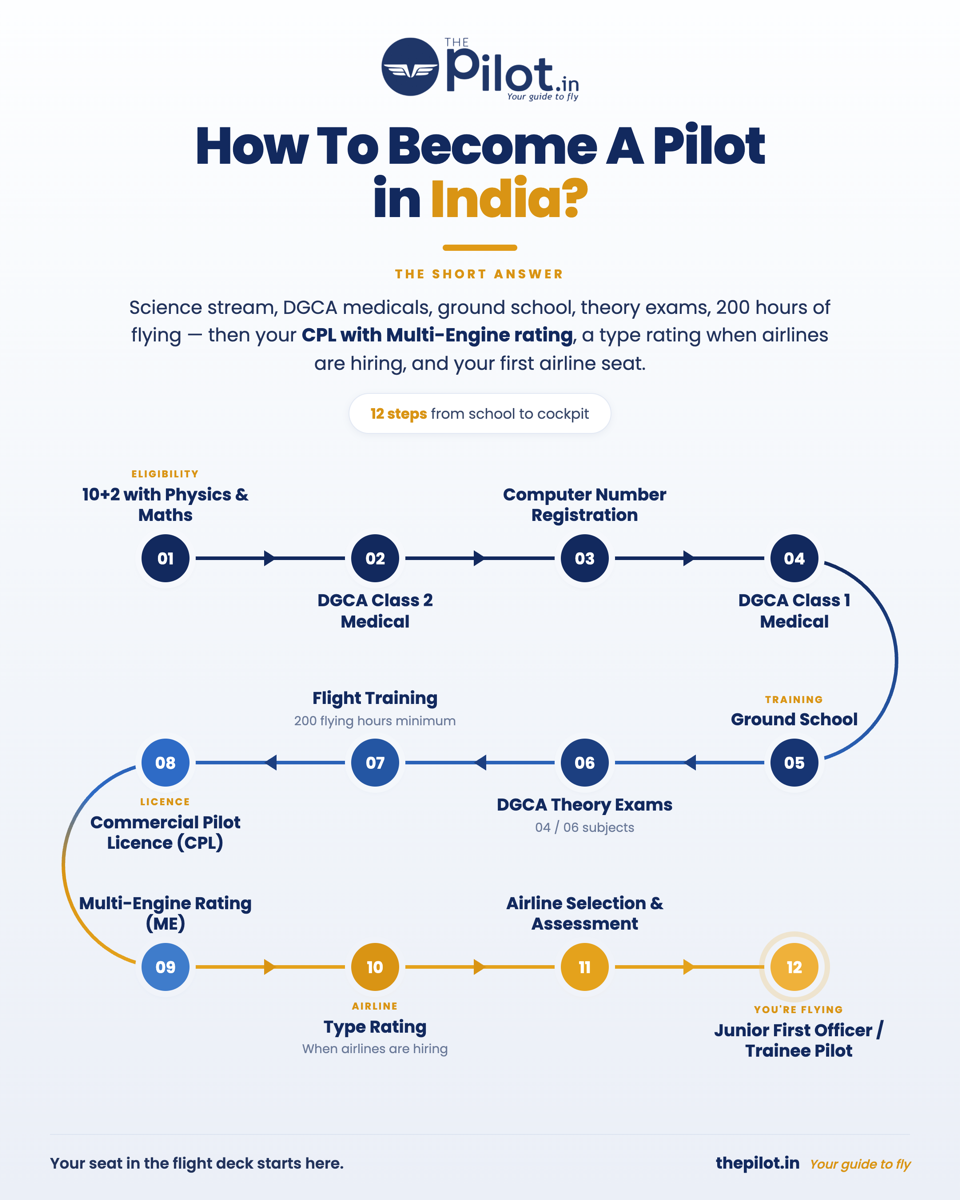
How To Become A Pilot
In India?
If You Only Read One Section Of This Guide, Read This
To become a Commercial Pilot in India, you need to complete 10+2 with Physics and Mathematics, pass the DGCA Class 2 medical, register for a Computer Number with DGCA, complete ground school, clear all DGCA theory examinations, pass the DGCA Class 1 medical, complete your flight training at an approved Flying Training Organisation (FTO), accumulate the required flying hours, and then obtain your Commercial Pilot Licence (CPL) with Multi-Engine rating.
From there you pursue an aircraft-specific type rating, often guided by current airline vacancies — if airlines are hiring type-rated pilots, a type rating becomes worthwhile.
The full journey typically takes 18 to 24 months, depending on your flying school, your pace, and the pathway you choose.

Step By Step Guide
For Commercial Pilot Training
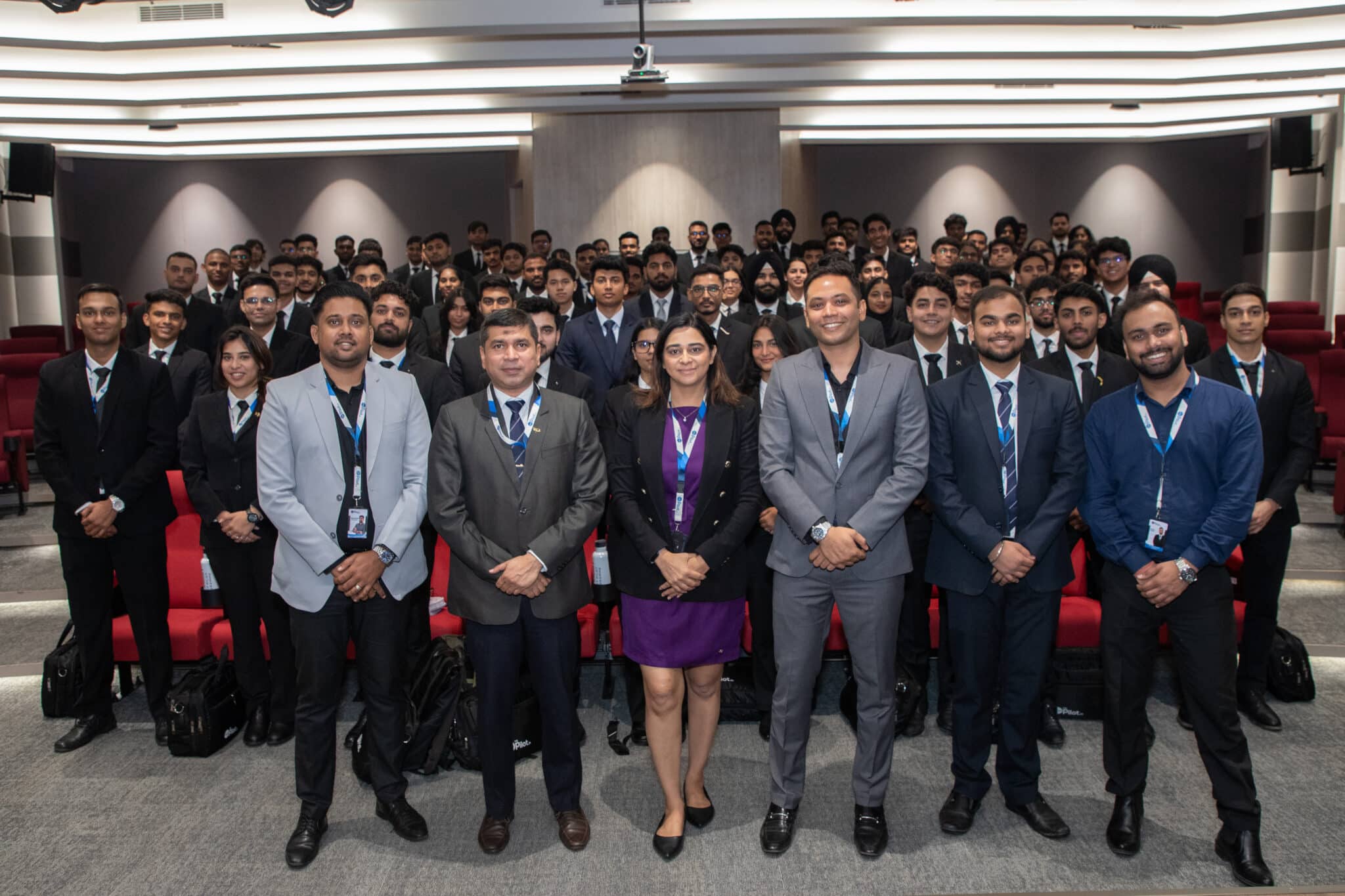
2,000+ pilots guided
your seat in the cockpit is closer than you think.
501 Reviews
★★★★★Pilot Eligibility Requirements In India
Before spending a rupee on pilot training, confirm that you meet DGCA's eligibility criteria. Here is what you need.
Education
Class 10+2 (HSC or equivalent) from a recognized board, with Physics and Mathematics passed at the 10+2 level — non negotiable for DGCA CPL eligibility
Minimum percentage
Conventional route: a pass in 10+2 with Maths & Physics — no minimum %. Cadet programs require a minimum: IndiGo 55%, Air India 60%
Nationality
Indian nationals apply for an Indian CPL through DGCA. OCI (Overseas Citizen of India) cardholders are also eligible to apply
Can Commerce / Arts students become pilots?
Yes. with one condition. If you didn't study Physics and/or Maths at 10+2, clear them as additional subjects through NIOS (or a state board allowing private candidates) and pass both. This adds ~6 months but is a legitimate, well-trodden route — many current airline pilots took it
Can graduates become pilots?
Yes. A graduation degree doesn't replace the 10+2 Physics & Maths requirement. If you graduated without them at 10+2, clear those subjects via NIOS. If you did study them at 10+2, your degree is a bonus — not a substitute
Age Requirements
There's no official upper age limit to begin training, but practical airline considerations apply. Airlines typically recruit First Officers up to about 40, and retirement age for Indian airline pilots is 65. Most students start between 17 and 25; beginning before 28 is generally advisable to maximise career length.
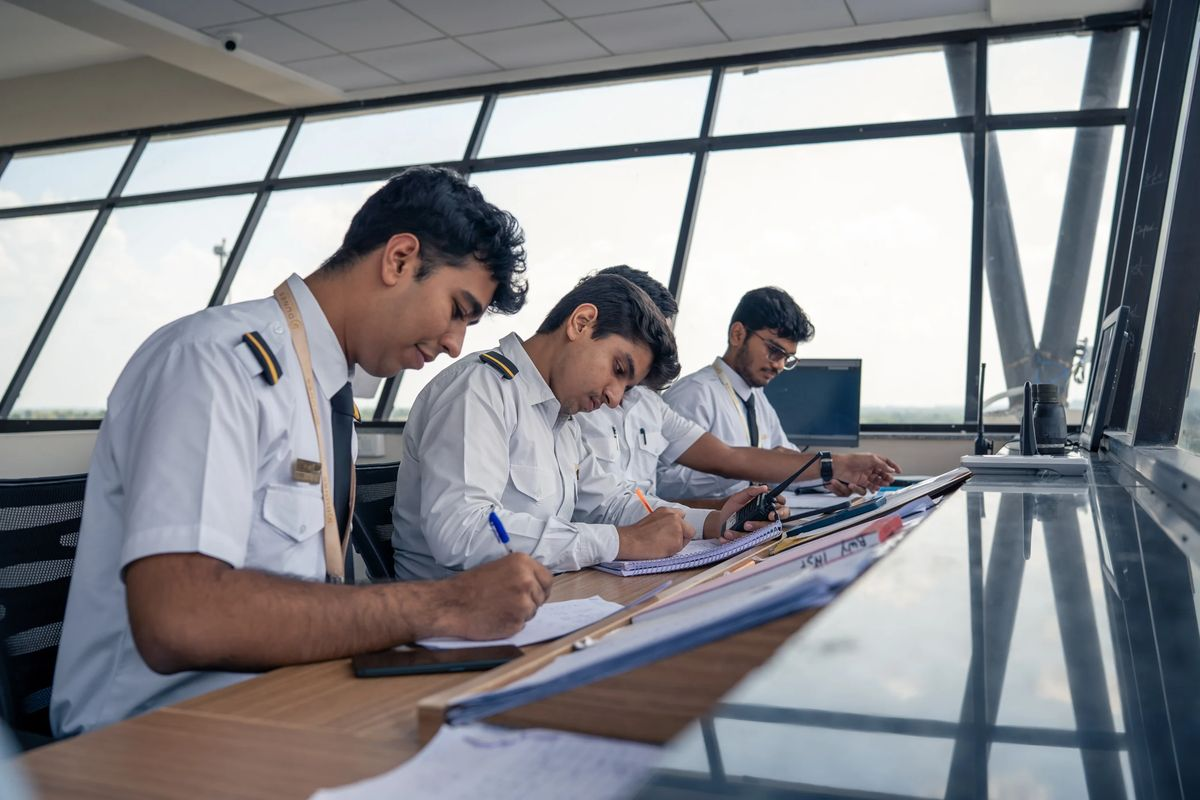
DGCA Medical Requirements For Pilots
The medical is the first gate. Clear it before investing in ground school or flight training — a disqualification mid-training is costly, financially and emotionally.
FOR SPL / PPL · VALID 2 YEARS
Required before you begin flight training; less stringent than Class 1. Conducted by DGCA-approved Aviation Medical Examiners.
- Vision: still distant & near, vision near (corrected or uncorrected)
- Normal colour vision
- ENT: no significant hearing/sinus/ear issues
- Cardiovascular: normal ECG & BP
- Neurological: no epilepsy/blackouts
- Psychological: no psychiatric illness/dependence
FOR CPL · RENEW ANNUALLY (6-MONTHLY AFTER 40)
Required before CPL issuance and more comprehensive than Class 2. Includes everything in Class 2, plus:
- Full ECG & audiometric testing
- Optometry: lying function
- Blood tests (glucose, cholesterol)
- Ophthalmology assessment
- Psychiatry evaluation (if history warrants)
- Spirometry, ENT & general fitness test
Colour Vision & Glasses
Normal colour vision is required for a DGCA Class 1 medical. Glasses are fine as long as vision corrects to 6/6. If you have any colour-vision concern, get assessed before beginning training or paying fees — this is non-negotiable.
BMI & Fitness
There's no fixed BMI cutoff in DGCA Class 1 standards. The AME assesses whether your physical condition lets you safely operate an aircraft and cockpit equipment. Fitness is judged holistically — neither extreme. Maintain a reasonable standard of health and there's no issue.
What If I Fail My Medical?
A failed medical is not automatically the end. DGCA splits unfitness into two categories — and the distinction matters enormously.
Temporarily Medically Unfit
Your current condition prevents certification, but it can be corrected — treatable conditions, recovered, healed or stabilised; you can be re-assessed and potentially cleared. Examples: active infections/illnesses, a healing fracture, paramount outside range that treatment can restore, post-surgical recovery, or a condition under investigation. Many pilots with a temporarily-unfit finding go on to obtain a full Class 1.
Permanently Medically Unfit
The condition is assessed as a permanent disqualification — typically irreversible and incompatible with safe flight (e.g. significant cardiac/neurological/vision deficiency). For CPL, certain cardiac conditions, epilepsy, severe uncorrectable vision loss, etc. can be referred for a Class 1 Medical Board (CMB). DGCA's senior review body, for a more detailed assessment.
How Much Does It Cost To Become A Pilot In India?
The most-asked question — and the one with the most misleading answers online. Here are the real numbers
Total cost to obtain a CPL in India typically ranges
Depending on flying school, aircraft type, location, and India vs abroad.
55 – 85 ₹ lakhs
| Training component | Estimated cost (2026) | Notes |
|---|---|---|
| DGCA Class 2 Medical | ₹5,000 – ₹10,000 | AME-approved clinic |
| DGCA Class 1 Medical | ₹10,000 – ₹20,000 | Required before CPL |
| Ground School (theory) | ₹1.5L – ₹3.5L | FTO or reputed ground classes |
| DGCA Exam Fees (6 subjects) | ₹2,500 – ₹5,000 | Per attempt, per subject |
| DGCA Computer Number | FREE | One-time registration |
| Flight Training | ₹55L – ₹75L | Largest variable cost |
| Multi-Engine Rating | ₹3L – ₹7L | Required for airline |
| RTR Licence Issuance | ₹10,000 | Radio licence |
| CPL Licence Processing (DGCA) | ₹10,000 – ₹15,000 | Application & issuance |
| Type Rating | ₹15L – ₹19L | If self-funded (not via cadet) |
| Accommodation & Living at FTOs | ₹6L – ₹12L | Depends on location & duration |
Hidden costs students often miss
- first-attempt pass rates run 70–80%; budget for re-attempts
- flying is skill-based; keep a 10–20% buffer
- Travel to/from a school in another city or state
- headsets, plotting tools, logbook supplies
Education loan options
- Loans up to 80% of the course
- Options for students who don't qualify for bank loans
India vs Abroad
cost comparison India
Approx ₹60L
India
Approx ₹60L
Weather delays; no licence conversion needed
 USA
Approx ₹65L
USA
Approx ₹65L
Fast completion, high-quality training
 South Africa
Approx ₹65L
South Africa
Approx ₹65L
Good weather, cost-effective
 New Zealand
Approx ₹70L
New Zealand
Approx ₹70L
High-quality, structured programs
 Australia
Approx ₹75L
Australia
Approx ₹75L
Premium training with Diploma in Aviation
 Maldives
Approx ₹60L
Maldives
Approx ₹60L
All-inclusive, good weather
Note: training abroad requires licence conversion to an Indian CPL (DGCA validation) — factor in conversion costs, additional testing and timeline.
How Long Does Pilot Training Take?
The honest answer: it depends. Here's what you can realistically expect at each stage.
1–1.5 years
All DGCA exams cleared first attempt, good aircraft availability, favourable weather, 200 hours within 12–15 months.
1.5–2 years
One or two exam re-attempts, moderate weather/aircraft delays, licence processing a couple of months. What most students experience.
2.5–3 years
Multiple exam failures, prolonged slots, medical review, or changing schools mid-training. Avoidable with the right school and preparation.
The Complete Step By Step Pilot Training Process
Every step you need to take — in the right order
-
STEP 1
Obtain DGCA Class 2 Medical
A medical by a DGCA-approved Aviation Medical Examiner (AME) that clears you to begin training.
When: Approved AMEs in major cities Cost: ₹3,000–₹10,000 Valid 2 years -
STEP 2
Obtain DGCA Class 1 Medical
A more comprehensive medical than Class 2, required before CPL issuance.
When: After clearing DGCA exams Valid 1 year -
STEP 3
Apply For Your Computer Number
A unique student-pilot registration number from DGCA. Without it you cannot sit DGCA exams.
How: DGCA Pariksha portal Processing: 1-3 weeks -
STEP 4
Enrol In Ground School
Theory training covering the DGCA CPL subjects — Air Regulations, Navigation, Meteorology, Technical General, Technical Specific and RTR. 4 subjects for training in India, more for training abroad.
Duration: 4-8 months -
STEP 5
Clear DGCA Theory Examinations
Written exams at DGCA centres; index all 6 subjects. Abroad: the first 4. Subjects: Air Regulations, Navigation, Meteorology, RTR(A), Technical General, Technical Specific.
Regular Examination On Demand Examination -
STEP 6
Complete Flight Training (India Or Abroad)
The flying portion — first solo through cross-country, instrument flying and the full 200-hour CPL syllabus with Multi-Engine rating.
200 hours total flying time 100 hours Pilot-In-Command (PIC) 50 hours cross-country PIC 40 hours instrument (min 20 on aircraft) 5 hours night PIC (10 take-offs & landings) -
STEP 7
Licence Conversion (If You Flew Abroad)
Convert your foreign licence to an Indian CPL through DGCA validation.
Valid foreign Commercial/Professional Pilot Licence + verification from the issuing authority Valid foreign Class 1 medical & valid DGCA Class 1 medical Authenticated 5-year logbook, verified by the issuing authority Valid skill-test certificates (single & multi-engine), proof of flying experience Skill checks in India to prove flying proficiency -
STEP 8
Obtain Your Commercial Pilot Licence (CPL)
The DGCA licence that authorises you to fly commercially. Apply through the DGCA portal.
All DGCA exams passed Class 1 medical valid Flying-hour requirements met RTR licence obtained Flying school documentation Skill test with DGCA examiner -
STEP 9
Type Rating & Airline Assessment
Preparing for airline assessments — simulator evaluations, ATPL theory, interview coaching and group exercises. ATPL theory isn't required for CPL, but many airlines test it in selection. Some institutes offer simulator familiarisation for airline-type assessments.
DGCA CPL Flying Hours Requirements
The DGCA prescribes a minimum flying-experience curriculum every CPL candidate must complete before licence issue. Here is what your logbook must show.
DGCA
Requirements
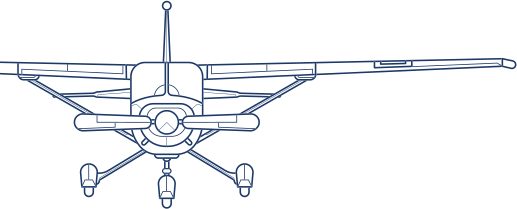


100 HOURS PILOT IN COMMAND (PIC)

250 NAUTICAL MILES (NM) CHECK

300 NAUTICAL MILES (NM) CHECK

10 TAKE OFF AND LANDING BY NIGHT

120 NAUTICAL MILES (NM) CHECK

10 HOURS MULTI-ENGINE

40 HOURS INSTRUMENT FLIGHT OUT OF WHICH 20 ON ACTUAL AND 20 SIMULATED

50 HOURS SOLO CROSS COUNTRY
Cadet Program Vs Conventional CPL
The most consequential decision in your pilot career. Both paths lead to the same cockpit — the route is very different. Here's an honest comparison
| Factor | Cadet Program | Traditional CPL |
|---|---|---|
| Structure | End-To-End Incl. Type Rating & Direct Airline Placement | Self-Managed — Training, Then Job Search |
| Cost | ₹90L – ₹1.05Cr (Incl. Type Rating) | ₹55 – ₹75L (Type Rating Separate) |
| Airline Pathway | LOI From Airline (Subject To Completion) | Not Guaranteed — Competitive Selection |
| Risk | Wash Out → You Lose Investment; Entry Is Competitive | More Flexibility, Multiple Airline Opportunities |
| Timeline | 2–2.5 Years, Structured, Less Prone To Delay | 1.5–2 Years, More Variation |
| Flexibility | Committed To One Airline's Program | Apply To Multiple Airlines |
| Selection | Rigorous — Aptitude, Medical, Simulator, Interview | Airline Selection After CPL — Separate Process |
| Best For You If | No Budget Constraint, Want A Certain Airline Pathway | Want Flexibility, Cost Control, Or Don't Meet Cadet Criteria |
Choose A Cadet Program If…
- You Score Well On Aptitude Tests And Perform Under Pressure
- You Want Certainty Of An Airline Pathway
- You're Comfortable Committing To One Airline's Bond
- You Can Meet The Financial Commitment Or A Cadet-Linked Loan
Choose Conventional CPL If…
- You Prefer Cost Control And Want To Compare Schools
- You Want To Train Internationally
- You Don't Meet A Specific Cadet Program's Criteria
- You Want To Apply To Multiple Airlines After Training
Cadet Program Reality Check
Cadet programs sound like the safest route — and for some students they are. But entering one doesn't guarantee you'll complete it: each stage has a screening gate and washout rates are real. Read your program contract carefully before signing. And whichever path you choose, pick a school on aircraft availability, instructor quality, completion record and location — never on fees alone.
Pilot Salary In India
A realistic career earnings guide — at each stage, not just the peak
Junior First Officer
New Joiner
₹90K – ₹1L / Mo
First Officer
Post-Probation
₹1.5L – ₹2.5L / Mo
Senior First Officer
₹3L – ₹4L / Mo
Captain
New Command
₹5L – ₹6L / Mo
Senior Captain
₹6L – ₹8L / Mo
Training Captain / TRI / TRE
₹9L – ₹10L / Mo
Approximate CTC (Cost To Company) Inclusive Of Flying Allowances. Take-Home Varies
Long-Term Earnings Potential
A pilot who joins at 24 and retires at 65 can realistically accumulate ₹10–20 Cr in lifetime earnings. The graph is steep once command upgrade happens — typically ~4 years in at major carriers. The challenge is the early years; the reward comes in the middle and later career.
You Have Your CPL. Now What?
The CPL isn't the end — it's the start of a different challenge: getting your first airline job.
Type Rating
A qualification to fly a specific aircraft type — Boeing 737, Airbus A320 or ATR 72. Airlines require pilots to be type-rated on the aircraft they operate. A CPL alone doesn't make you type rated. You can self-fund a type rating (₹15–19 lakhs) at an approved simulator centre, in India or abroad depending on aircraft type and slot availability.
Airline Assessments
- Application Screening — Hours, Medical, Licence Verification
- Aptitude Testing — Psychometric & Cognitive Battery
- Group Discussion — Attitude, DBM, Decision-Making
- Simulator Evaluation — Handling, Instrument Flying, CRM
- Technical Interview — Systems, Airmanship, Scenarios
- HR Interview — Communication, Judgment, Crew Dynamics
Most Airlines Require 200 Hours Minimum For Initial Selection; Competitive Candidates Carry Extra Qualifications
Common challenges after CPL
The type-rating cost gap: most CPL holders don't have ₹15–19 lakhs ready for a self-funded rating. Post-CPL financial pressure: if you borrowed to train, repayments begin at graduation — job or not. Budget for a 6–12 month period before your first airline payslip.
Advice From An Airline Pilot
The CPL isn't the end — it's the start of a different challenge: getting your first airline job.
Capt. Hardik Jani
Leadership at ThePilot.in
Urvi Jani
Leadership at ThePilot.in
Common Challenges After CPL
have guided over 2,000 aspiring pilots. Here's what they tell every student before training
Do your medical before paying deposits
Thousands have paid big fees before finding a disqualification. The medical is cheap and quick — do it first, always
Don't choose a school on cost alone
The cheapest school is rarely the best value. Aircraft downtime and poor facilities cost you far more in delayed hours than you saved in fees
Research aircraft availability before you sign
Ask: how many students per aircraft? Average monthly hours per student? What happens in the monsoon? Their answers tell you everything.
Understand the hiring landscape
Training in 2026 means entering the workforce in 2028–2031. Know which fleets are expanding and what will be in demand. Train with that endpoint in mind.
DGCA exams are harder than you expect
First-attempt failure rates are significant. Allocate proper time, use structured material, take coaching seriously — clearing all six first time saves time and money.
The post-CPL phase is hardest financially
You finish with a CPL and little income for 12–18 months. Plan your finances — don't run out of runway when you're closest to the destination.
It's a marathon, not a sprint
Students who rush every stage make more mistakes and arrive less prepared. Pace yourself; build genuine competence at each stage
Community matters as much as curriculum
The pilots you train alongside become your network for three decades. Choose an environment where the culture is serious and collaborative
Get counselling before you start
Too many students reach out after costly decisions. A free 30-minute conversation with an experienced pilot at the start can save years of wrong turns.
Frequently Asked Questions
We've answered 2,000+ questions from aspiring pilots. These are the ones we hear most.
Eligibility
Can Commerce Students Become Pilots In India?
Can Arts Students Become Pilots?
What Is The Minimum Age To Become A Pilot In India?
Is There A Maximum Age To Become A Pilot?
What Percentage Do I Need In 12th To Become A Pilot?
Can A Graduate Become A Pilot?
Can Women Become Airline Pilots In India?
Can I Become A Pilot If I Have Asthma?
Medicals
Can Pilots Wear Glasses In India?
What If I'm Colour Blind?
Is LASIK Surgery Allowed For Pilots?
How Often Do Pilots Need Medical Renewals?
Cost
What Is The Total Cost To Become A Pilot?
Can I Get An Education Loan For Pilot Training?
Is Pilot Training Tax Deductible?
What Are The Hidden Costs Of Pilot Training?
Is Training Abroad Cheaper Than India?
Training
How Many Hours Of Flying Are Required For A CPL In India?
How Difficult Are DGCA Exams?
How Many Attempts Are Allowed For DGCA Exams?
What Happens If I Fail A DGCA Exam?
How Do I Choose The Right Flying School In India?
What Is A Flying Training Organisation (FTO)?
Can I Do My Ground School Online?
Cadet Programs
What Is A Cadet Pilot Program?
How Do I Apply For IndiGo's Cadet Program?
What Are The Eligibility Criteria For Most Cadet Programs?
Is A Cadet Program Better Than Traditional CPL?
Do Cadet Programs Require A Bond?
CPL & Post-CPL
What Is The Difference Between CPL And ATPL?
What Is A Type Rating And Why Do I Need It?
How Long Is A CPL Valid?
Can I Fly Internationally With An Indian CPL?
Airline Jobs
What Airlines Hire Fresh CPL Holders In India?
How Many Hours Do I Need To Get An Airline Job?
What Is The Hiring Process Like At Indian Airlines?
What Is A Junior First Officer (JFO)?
International Training