Rank & seniority
The biggest jump comes at command upgrade, when a First Officer becomes a Captain, typically a few years into an airline career.
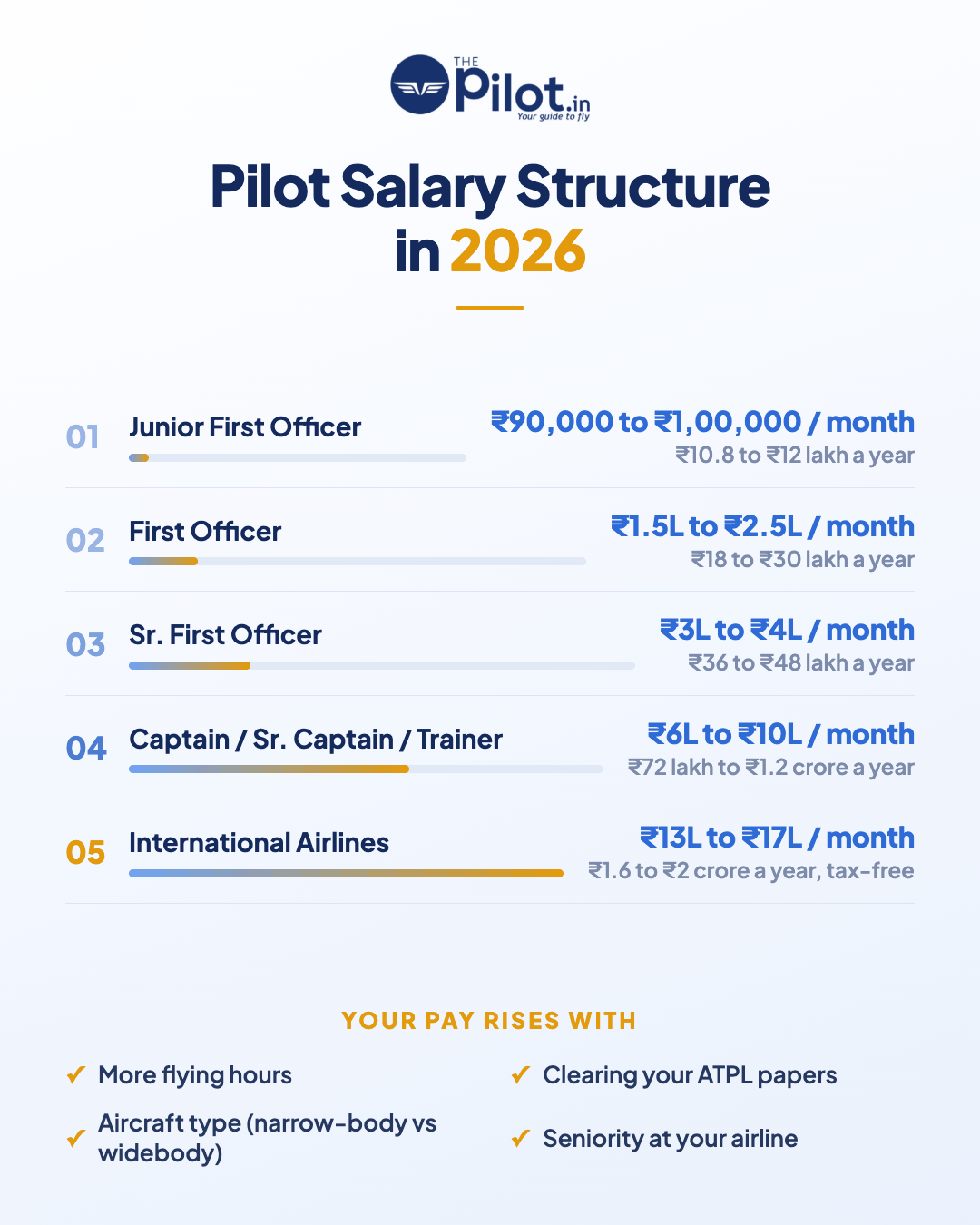
The salary for pilots in India varies with rank, airline and flying hours. Commercial pilots in India earn ₹80,000–1.5 lakh/month as Trainee First Officers, ₹1.5–3.5 lakh as First Officers, ₹5–10 lakh as Captains, and ₹8–15 lakh+ as Senior Captains (2026). Fixed pay is topped up with a ₹10,000–15,000 per-hour flying allowance. Command typically comes 4–6 years after joining an airline.
Written by Capt. Hardik, A320 Captain · Reviewed by the ThePilot.in editorial team · Updated August 28, 2026
Approximate 2026 figures; final take-home varies with airline, flying hours and allowances. See the full rank-by-rank table with annual figures below.
A pilot's monthly earnings in India depend on rank, airline, and flying hours. A Junior First Officer starts at ₹80,000–1.5 lakh per month. A First Officer earns ₹1.5–3.5 lakh, a Senior First Officer earns ₹3–4.5 lakh, and a Captain earns ₹5–10 lakh per month. Senior and international Captains reach ₹8–15 lakh+ per month on wide-body fleets.
These figures combine fixed pay with a flying allowance of ₹10,000–15,000 per flying hour, which is why two pilots of the same rank can take home different amounts in the same month.
The salary for pilots in India depends more on which airline you join than almost anything else. Two first officers with identical licences and hours can take home very different amounts depending on the carrier, the fleet, and how many hours they fly above their guaranteed block. Here's how the major airlines compare in 2026.
| Airline | Junior / First Officer | Senior First Officer | Captain | Notes |
|---|---|---|---|---|
| IndiGo | ₹2–3 lakh | ₹3–5 lakh | ₹7–10 lakh | LCC · fastest command upgrade |
| Air India | around ₹3.3 lakh* | ₹4–5.5 lakh | around ₹8.3 lakh* | FSC · widebody + international |
| Air India Express | ₹2.5–3 lakh | ₹3–4.5 lakh + fleet allowance | ₹6–8 lakh + fleet allowance | Narrow-body · short-haul intl |
| Akasa Air | ₹2–2.5 lakh | ₹3.4 lakh+ | ₹6.5–8 lakh | LCC · new fleet growth |
| SpiceJet | varies — see note | varies | varies | LCC · variable roster |
All figures are monthly, indicative ranges from pay revisions reported in 2025–26 and pilot-reported data. Actual pay varies with fleet, base and flying hours.
*At around 55 flying hours, after Air India's August 2026 revision.
IndiGo operates the largest fleet in the country, so it hires the most and its pay bands effectively set the market. A junior first officer starts around ₹2–3 lakh a month, moves to ₹3–5 lakh as a senior first officer, and captains typically earn ₹7–10 lakh. Line training captains and senior commanders cross ₹10 lakh. Pay is structured as a guaranteed block of flying hours plus per-hour allowances above it, so months with heavy rosters pay noticeably more.
In August 2026, Air India and Air India Express revised pilot pay upward by roughly 8–15%, with some senior commanders seeing up to 17%. A first officer now earns around ₹3.3 lakh a month at about 55 flying hours, and captains around ₹8.3 lakh. Air India Express also introduced a Boeing 737 fleet allowance — up to ₹21 lakh for senior commanders and ₹10 lakh for senior first officers, paid in instalments from October 2026. If you're comparing offers, ask how much of the package is guaranteed and how much depends on flying hours.
Akasa raised pilot pay sharply after 2023 to stay competitive — senior first officers moved to around ₹3.4 lakh a month, and a first officer flying a 60-hour month could cross ₹4 lakh. Captains typically earn in the ₹6.5–8 lakh range. Akasa publishes less pay information than the bigger carriers, so treat these as indicative and confirm current bands during recruitment.
SpiceJet's pay has historically trailed IndiGo and Air India, and it has had publicised stretches of delayed salaries. We'd rather not print a number we can't stand behind — if you're considering an offer, ask for the guaranteed monthly component in writing and talk to serving line pilots. For most fresh CPL holders in 2026, IndiGo, Air India group and Akasa are the benchmarks to compare against.
LCCs (low-cost carriers) like IndiGo and Akasa offer faster fleet growth and upgrade timelines; FSCs (full-service carriers) like Air India offer wide-body international flying with higher allowance income. Structured entry routes such as the Air India cadet pilot program fix your airline before training begins.
The headline number is never the whole story. A typical airline package in India is made of a basic salary, a guaranteed block of flying hours (usually 40–70 hours a month depending on the airline), per-hour flying allowance above that block, layover and night-stop allowances, and annual components like leave travel and insurance. Two practical consequences:
| Stage | Typical timeline | What you earn |
|---|---|---|
| Student pilot (CPL training) | 18–24 months | Nothing — you're paying fees (see our full cost breakdown) |
| Type-rated, awaiting induction | 3–12 months | Usually unpaid; some airlines pay a small stipend during line training |
| Junior first officer | Years 0–3 | ₹1.5–3 lakh/month |
| Senior first officer | Years 3–7 | ₹3–5 lakh/month |
| Captain (narrow-body) | Years 7–12 | ₹6–10 lakh/month |
| Wide-body / training captain | Years 12+ | ₹10 lakh+ /month |
The honest version of this table is the part most sites skip: there's a gap between finishing your CPL and drawing your first airline salary, and it can run over a year. Budget for it. Once you're in the right seat, though, progression is faster in India right now than almost anywhere — airlines have hundreds of aircraft on order and command upgrades are coming earlier than they did a decade ago.
Five factors move a pilot's pay more than anything else: rank (the FO-to-Captain upgrade roughly triples earnings), flying hours logged per month, aircraft type (wide-body and international fleets attract higher allowances), airline type (LCC vs FSC pay structures), and seniority, which decides upgrade order at every Indian carrier.
The biggest jump comes at command upgrade, when a First Officer becomes a Captain, typically a few years into an airline career.
Clearing your ATPL papers moves a First Officer into a higher band (around ₹3–4.5 lakh per month) and is a prerequisite for command.
Type rating and the aircraft you fly (A320, B737, widebody) affect pay scales and allowances at most airlines.
Pay differs across carriers, and changes with company policy and crew agreements, so ranges shift over time.
A large part of a pilot's pay is flying allowance, so hours flown and roster directly affect monthly take-home.
International and widebody operations, plus layover allowances, can lift earnings beyond domestic narrow-body flying.
After earning a CPL (Commercial Pilot Licence) and joining an airline, you move through five broad stages:
| Designation | Eligibility | Monthly | Annual | Notes |
|---|---|---|---|---|
| Trainee / Junior First Officer | Under 1,000 hours from joining | ₹80,000–1.5 lakh | ₹10–18 lakh | First airline posting |
| First Officer (Co-Pilot) | From 1,000 hours until ATPL | ₹1.5–3.5 lakh | ₹18–42 lakh | Flying allowances add on top |
| Senior First Officer | ATPL at 2,500–3,000 hours | ₹3–4.5 lakh | ₹36–54 lakh | Gateway to command |
| Captain (Domestic) | After command training | ₹5–10 lakh | ₹60 lakh–1.2 Cr | Narrow-body scheduled |
| Senior / International Captain | Wide-body + TRI / TRE eligible | ₹8–15 lakh+ | ₹1–1.8 Cr+ | Gulf / US carriers often tax-free |
The single biggest pay jump in a pilot's career is the upgrade to command. Clearing your ATPL (Airline Transport Pilot Licence) exams early keeps that timeline on track — the same DGCA subjects we teach in our DGCA Ground Classes.
A fresh CPL holder joining an airline as a Junior First Officer starts at around ₹80,000–1.5 lakh per month (₹10–18 lakh per year). During type-rating and line training, stipends can be lower. Pay rises quickly with hours: most pilots cross ₹1.5 lakh per month within 2–3 years of joining.
What can you earn while building hours?
There is no pilot salary "after 12th" — you first complete 10+2 with Physics and Maths, obtain a DGCA Class 1 Medical, finish flight training (around 200 flying hours), and clear your CPL exams. The full path is covered in our guide on how to become a pilot in India.
| Component | What it covers | Typical range |
|---|---|---|
| Fixed base pay | Rank-linked monthly salary | Set by airline pay scale |
| Flying allowance | Paid per flying hour | ₹10,000–15,000/hour |
| Domestic layover allowance | Per night away from base | ₹2,000–4,000/night |
| International layover allowance | Per night abroad | ₹15,000–30,000/night |
Add health and life insurance, and concessional or free air travel for the pilot and immediate family at most carriers. Because flying allowance is hour-based, a month with heavy rostering can lift a First Officer's take-home well above the base band.
Flight instructors at Indian FTOs (Flying Training Organisations) earn ₹1–3 lakh per month; instructors at private academies typically earn ₹80,000–2 lakh.
₹1L – ₹3L
₹80k – ₹2L
Pay scales with instructional ratings, aircraft type, and monthly flying hours. Instructing is also a common route to building the PIC (pilot-in-command) hours that airline recruiters and the DGCA require for command upgrades.
The fastest levers, in order of impact: clear ATPL exams as early as eligibility allows, complete command upgrade at the minimum hour requirement, move to wide-body or international operations, add a Type Rating on an in-demand fleet such as the A320 or B737, and progress into training roles (TRI/TRE), which carry trainer allowances on top of Captain pay.
ATPL papers move a First Officer into a higher band and are a prerequisite for command, so clearing them early pulls your whole pay curve forward.
Upgrading from First Officer to Captain is the single biggest jump in a pilot's earnings. With current fleet expansion, command can come in roughly 5 to 6 years rather than the old 8 to 10.
Much of a pilot's pay is a per-hour flying allowance on top of base pay, so a fuller (legal, rested) roster directly lifts monthly take-home.
Training Captain, Type Rating Instructor (TRI) and Examiner (DE) duties carry extra allowances on top of a Captain's salary.
Larger aircraft and long-haul international routes add layover allowances and generally sit on higher pay scales than domestic narrow-body flying.
Carriers expanding their fleets upgrade First Officers to Captain faster, which shortens the time to your biggest pay rise.
Training Captains and examiners on wide-body international fleets earn the most in India — ₹1–1.2 crore per year, and above that at the seniormost levels once trainer allowances and international per diems are counted. They combine command pay, instructor allowances, and the highest layover income in the industry.
Top in India
₹1 – 1.2 Cr / yr
Senior Captains and Trainers (Training Captains, TRI, DE) flying widebody aircraft.
Top abroad · tax-free
₹1 – 1.8 Cr / yr
Indian Captains who join Emirates, Etihad, Qatar Airways or Riyadh Air, where pay is often tax-free.
The biggest jump beyond India's ceiling comes from moving to an international carrier. For most pilots, though, an established Captain's package of ₹60 lakh to ₹1.2 crore a year already places them among India's higher-earning professionals.
Yes, though typically via international careers. Senior Captains at Gulf and East Asian carriers earn ₹8–15 lakh+ per month (₹1–1.8 crore per year), often tax-free in the UAE and Qatar. Indian carriers' seniormost training captains approach ₹1.2 crore+. An Indian CPL can be converted for foreign airline employment — see our CPL conversion guide.
Finish your CPL and an A320 or B737 type rating. A type rating doesn't pay a salary on its own, but it's what lets an airline put you on a paying aircraft.
Your first airline payslip. Pay is modest while you settle into line flying and build experience.
This is the CPL-versus-ATPL jump. A CPL gets you the right-hand seat; clearing your ATPL papers moves you into the Senior First Officer band and is a prerequisite for command.
The single biggest pay jump of your career is command — this band pays around ₹60 lakh – ₹1.2 cr / yr. Command today can come in roughly 4 to 6 years rather than the old 8 to 10. From there, Senior Captain, Training Captain, TRI and DE roles on widebody aircraft take you to the top of the India scale. To earn beyond that, the next move is an international carrier.
Many of the most experienced commanders move to international carriers such as Emirates, Etihad, Qatar Airways and Riyadh Air, where widebody Captain packages are widely reported at around ₹1 crore to ₹1.8 crore a year, and often tax-free in the Gulf.
Indian pilot pay is strong by domestic standards, but the Gulf carriers sit in a different bracket. Here's the honest comparison.
₹60 lakh – ₹1.2 cr / yr
A strong, taxable package at a major Indian carrier, rising with seniority, trainer roles and widebody flying.
₹1 – 1.8 cr / yr, tax-free
Captains, Sr. Captains and Trainers at Emirates, Etihad, Qatar Airways and Riyadh Air are widely reported to earn around ₹1 crore to ₹1.8 crore a year, and in the Gulf that pay is tax-free.
That gap, mostly at the widebody Captain level, is why many experienced Indian commanders eventually move to the Middle East. The same split shows up within India too: international widebody routes carry higher pay scales and larger layover allowances than domestic narrow-body flying. Most pilots build their command and hours in India first, then weigh a move abroad.
When it comes to pay, there's no difference at all. An airline salary is set by rank and seniority, not gender, so a woman First Officer or Captain earns exactly the same as any other pilot at that rank. Every figure on this page applies equally.
India also leads the world here: it has the highest number of women airline pilots of any country, so you would be joining the largest community of women pilots anywhere.
Same
pay scale, set by rank and seniority, not gender
Highest
number of women pilots of any country in the world
Yes, comfortably. CPL training costs ₹55–85 lakh. A pilot who reaches command in 5–6 years then earns ₹60 lakh–1.2 crore per year, paying back the training in 1–2 years of Captain pay. Cumulative career earnings from age 24 to 65 run into tens of crores.
Training cost
₹55–85 lakh
CPL, hours and type rating
Captain earnings
₹60L–1.2 cr
per year, once in command
Payback
~1–2 years
of command pay covers the full cost
The ₹55 lakh to ₹85 lakh you spend on training is real money. But a Captain earning ₹60 lakh to ₹1.2 crore a year earns it all back in a year or two, then keeps earning at that level for the next two to three decades. Over a full career, the training cost is a small fraction of what you take home.
The only hard part is the start. The Junior First Officer years are tight, especially with a loan to service, but that stretch is temporary. Clear your DGCA exams cleanly and build your hours efficiently, and you reach command, and the real money, sooner. Still mapping the path? Start with our guide on how to become a pilot in India.
Now that you know the numbers, here's where most students go next.
See the ₹55–85 lakh breakdown: DGCA ground school, 200 flight hours, type rating and everything in between.
Step-by-step: eligibility, medical, ground school, flying hours, type rating, first job — timelines and choices at each stage.
Get selected directly into an airline. See how the IndiGo cadet track works and what selection expects.
Still have questions about pilot salary or training?
Ask us on WhatsAppA fighter pilot's pay looks small next to an airline captain's, but the comparison isn't straightforward. A newly commissioned Flying Officer earns a basic pay of ₹56,100 (Level 10), plus ₹15,500 military service pay and around ₹25,000 flying allowance — roughly ₹1.1–1.35 lakh a month gross with DA and HRA. That's well below airline pay. What the IAF side of the ledger has: zero training cost (airline training costs ₹1–2 crore of your own money), complete job security, and a lifelong pension. Many IAF pilots also move to airlines after their service commitment, entering with experience the airlines value.
Details: careerairforce.gov.in
Not every pilot flies for a scheduled airline. Helicopter pilots in India — offshore (flying to oil rigs), charter and corporate — typically earn between ₹1.5 lakh and ₹4 lakh a month depending on experience and operation type, with offshore work at the top of that band. Business jet captains flying for corporate owners or charter operators generally earn ₹5–10 lakh a month, and the senior end can match airline wide-body pay. These jobs hire in smaller numbers and lean heavily on experience, so they're usually a mid-career move rather than a first job.
Everything you need to become a commercial pilot: from DGCA Ground Classes and flight training to airline cadet programs, type rating, career guidance, and expert counselling.