DGCA Class 2 medical
The first medical for student pilots, required before solo flying. It is done by a DGCA-empanelled medical examiner and usually comes before Class 1.
2026 Cadet Pilot Guide
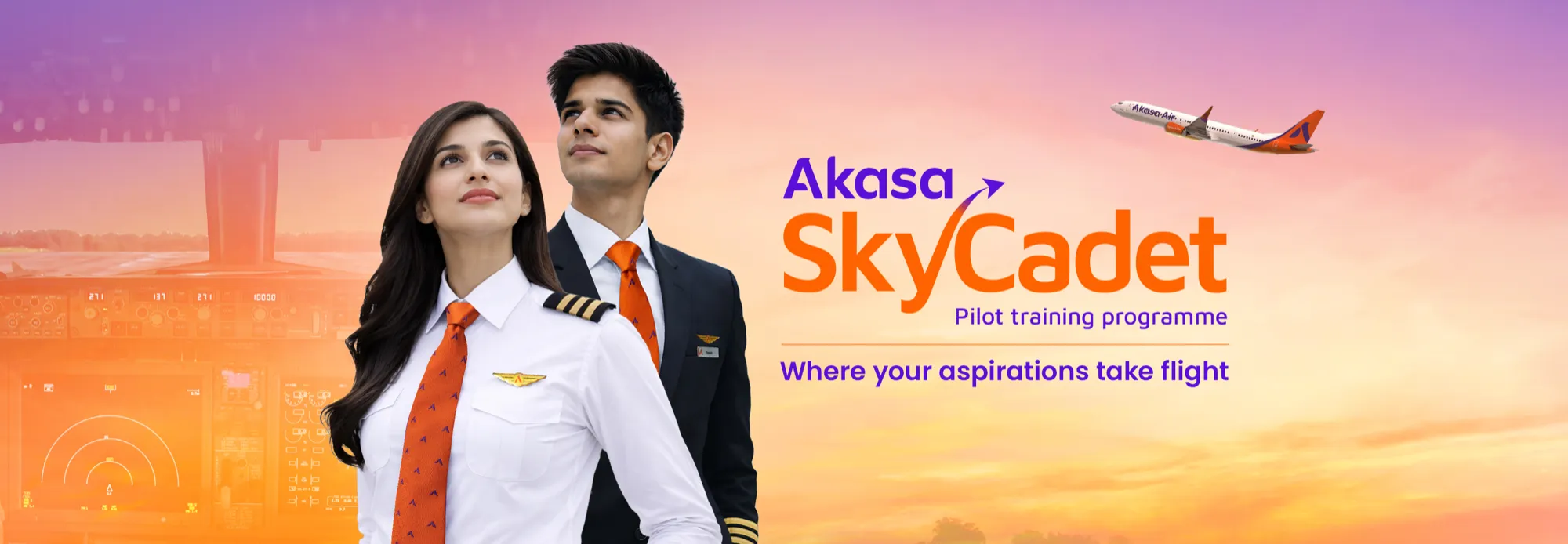
Akasa Air's SkyCadet Pilot Training Programme trains aspiring pilots in three phases: ground school, CPL flight training and a Boeing 737 MAX type rating. Here is what Akasa Air has published and how to prepare.
Overview
Akasa Air's SkyCadet programme takes selected Indian citizens through ground school, CPL flight training with one of two partner schools in India, and a Boeing 737 MAX type rating.
Operated by
Akasa Air (SNV Aviation Pvt Ltd)
Training partners
Two flying schools in India
Type rating
Boeing 737 MAX
Age limit
18 to 40
Eligibility
Indian citizens only
Min 18 at application, max 40 at enrolment
10+2 with Physics, Maths and English
Written and spoken proficiency
No criminal record or disciplinary action
DGCA Class 1 to hold a CPL
Unless labelled, each item is an official requirement published by Akasa Air.
How to become a pilot in IndiaTraining
Air Regulations, Meteorology, Navigation, Aircraft Technical Knowledge and Human Performance, for the DGCA exams.
Dual and solo flying, from basic manoeuvres to navigation, instrument and cross-country flying, ending with the CPL skill test.
DGCA theory exams, skill tests, Class 1 medical, RTR(A) and English Language Proficiency.
Full-flight simulator sessions, aircraft systems, standard operating procedures and performance-based training.
Akasa Air induction and supervised line training, on Akasa Air's terms.
Locations
Bhavnagar Airport, Gujarat, India
Jalgaon, Maharashtra, India
Which partner you join and the schedule are decided by Akasa Air.
Medical
General information only. For your own case, consult a DGCA-empanelled medical examiner.
The first medical for student pilots, required before solo flying. It is done by a DGCA-empanelled medical examiner and usually comes before Class 1.
Required to hold a Commercial Pilot Licence and fly for an airline. It includes detailed checks such as ECG, vision, colour vision, hearing and blood tests.
Before you invest in training. Clearing Class 2 early, and Class 1 as soon as you can, protects you from paying for a programme you cannot medically complete.
Some findings are temporary and can be reassessed after treatment; others may be permanent. DGCA has a review process. Only a DGCA medical examiner can assess your case.
Timeline
Fees
Akasa Air does not publish the SkyCadet fee on its programme page.
The fee structure is shared within the SkyCadet application form.
Akasa Air says it does not engage or endorse any third party for induction training. Apply only through its official page.
Documents
The final list is set by the airline's official notice.
Career
CPL
DGCA licence issued
Type rating
Airline aircraft type
Airline training
Induction and SOPs
Line training
Supervised flights
First Officer
Right seat
Completion of training does not automatically mean unconditional employment unless this is explicitly stated in the programme agreement.
Akasa Air does not publish cadet salaries. Pay depends on the airline, rank, aircraft, flying hours, allowances, base, experience and contract.
Before you commit
How ThePilot.in helps
Practice for the common pilot aptitude tests: ADAPT, COMPASS and cut-e.
Personality and psychometric test practice.
GD and PI practice for the selection rounds.
Classroom batches in Borivali West, Mumbai, and live online batches.
Learn more about dgca ground classesShortlist flying schools in India and abroad.
Learn more about flight training guidanceOne-to-one counselling on cadet and self-sponsored routes.
ThePilot.in is independent and is not affiliated with or endorsed by Akasa Air. Final selection is made by Akasa Air.
Compare
| Feature |
 Explore Air India |
Akasa Air You're on this page | IndiGo Explore IndiGo |
|---|---|---|---|
| Age limit | 18 to 30 | 18 to 40 | Set by each school (Skyborne: 18 to 40) |
| Training model | Air India academy or US partner schools | Two partner schools in India | Six partner flying schools |
| Training location | Amravati, Phoenix or Sanford | Bhavnagar or Jalgaon | India, USA, Thailand, South Africa, Australia or New Zealand |
| Type rating | Assigned by Air India | Boeing 737 MAX | Airbus A320 |
| Official fee | Shared after enrolment | Shared in the application form | Set by each partner school |
| Employment | As per the programme agreement | As per the programme agreement | As per the programme agreement |
FAQs
At least 18 when you apply and no older than 40 when you enrol, according to Akasa Air.
Indian citizens with 10+2 in Physics, Mathematics and English, written and spoken English proficiency, and no criminal record or history of disciplinary or legal action.
Yes. DGCA requires Physics and Mathematics at 10+2 level (or equivalent) to issue a Commercial Pilot Licence, so both subjects are needed for every Indian airline cadet programme.
Yes, once they have passed Physics and Mathematics at 10+2 level. Students who did not take these subjects can clear them through NIOS and apply after the results are declared.
English is assessed in tests and interviews. For licensing, DGCA also requires English Language Proficiency at ICAO Level 4 or above and the RTR(A) radio licence.
Class 2 is the student-pilot medical needed before solo flying. Class 1 is the more detailed medical required to hold a CPL and fly commercially. Both are issued under DGCA standards.
DGCA standards allow corrective lenses within defined limits; colour vision is assessed more strictly. A DGCA-empanelled examiner assesses each case.
It looks at how you think and behave rather than what you know, for example spatial orientation, multitasking, decision-making and personality. Consistent, honest answers matter more than "ideal" ones.
Expect questions on motivation, communication, teamwork and the airline itself. Panels look for clear, composed and genuine answers rather than memorised scripts.
The Boeing 737 MAX.
Akasa Air names two training partners: Dunes Aviation Academy at Bhavnagar, Gujarat, and Skynex Aero at Jalgaon, Maharashtra.
DGCA requires a minimum of 200 hours of flight time for a CPL, including set amounts of pilot-in-command, cross-country, instrument and night flying, plus passes in the DGCA theory exams.
A type rating is the aircraft-specific qualification needed to fly a particular airliner. It is mostly simulator-based and covers systems, normal procedures and emergencies on that type.
Akasa Air does not publish the fee on its programme page. The fee structure is shared within the application form.
Each programme sets what its fee covers. Some fees cover ground school, flight training and type rating; others leave out medicals, DGCA exams, licensing, accommodation or travel. Ask for a written list of what is included.
Completion of training does not automatically mean unconditional employment unless this is explicitly stated in the programme agreement. Read the agreement carefully before you sign.
No. ThePilot.in is independent and is not affiliated with or endorsed by Akasa Air. We help candidates prepare; applications go only through Akasa Air's official page.
After line training you fly as a First Officer, then Senior First Officer. A command upgrade needs an ATPL, airline assessments and a vacancy. Timelines vary between airlines.
Usually Class 10 and Class 12 certificates, NIOS records if applicable, a valid passport, photo ID, medical documents and photographs. The exact list is set by the airline's official notice.
Reviewed by ThePilot.in Aviation Team. Last updated 23 November 2026. Airlines can change requirements, fees and partners at any time, so always check the latest official notice.
Next step
Get clear on eligibility, selection and costs before you apply.
ThePilot.in is independent and is not affiliated with or endorsed by Akasa Air. Final selection is made by Akasa Air.
Everything you need to become a commercial pilot: from DGCA Ground Classes and flight training to airline cadet programs, type rating, career guidance, and expert counselling.